
Why do companies go public? The obvious answer is money.
After losing influence at his first company, Zip2, and being forced out as CEO of PayPal, Musk became very protective of control over his companies.
Going public can raise a lot of money, but it can also dilute that control and create pressure to prioritize short-term results. That pressure runs against his strategy of investing aggressively in long-term goals. For years, he resisted taking SpaceX public.

But in June 2026, SpaceX went public.
It wasn’t the first time the company had needed enormous amounts of capital. For years, it had funded ambitious projects while remaining private.
So what had changed? Why choose an IPO this time instead of continuing to raise capital privately? And what would happen to Musk's control?
I
In fact, what Musk took public wasn't just a rocket company. Earlier this year, SpaceX acquired xAI, which already owned X. He then took the combined company public.
The timeline looks like this:
2022: Musk acquires Twitter
2023: Musk founds xAI and rebrands Twitter as X
2025: xAI acquires X
February 2026: SpaceX acquires xAI
June 2026: SpaceX goes public
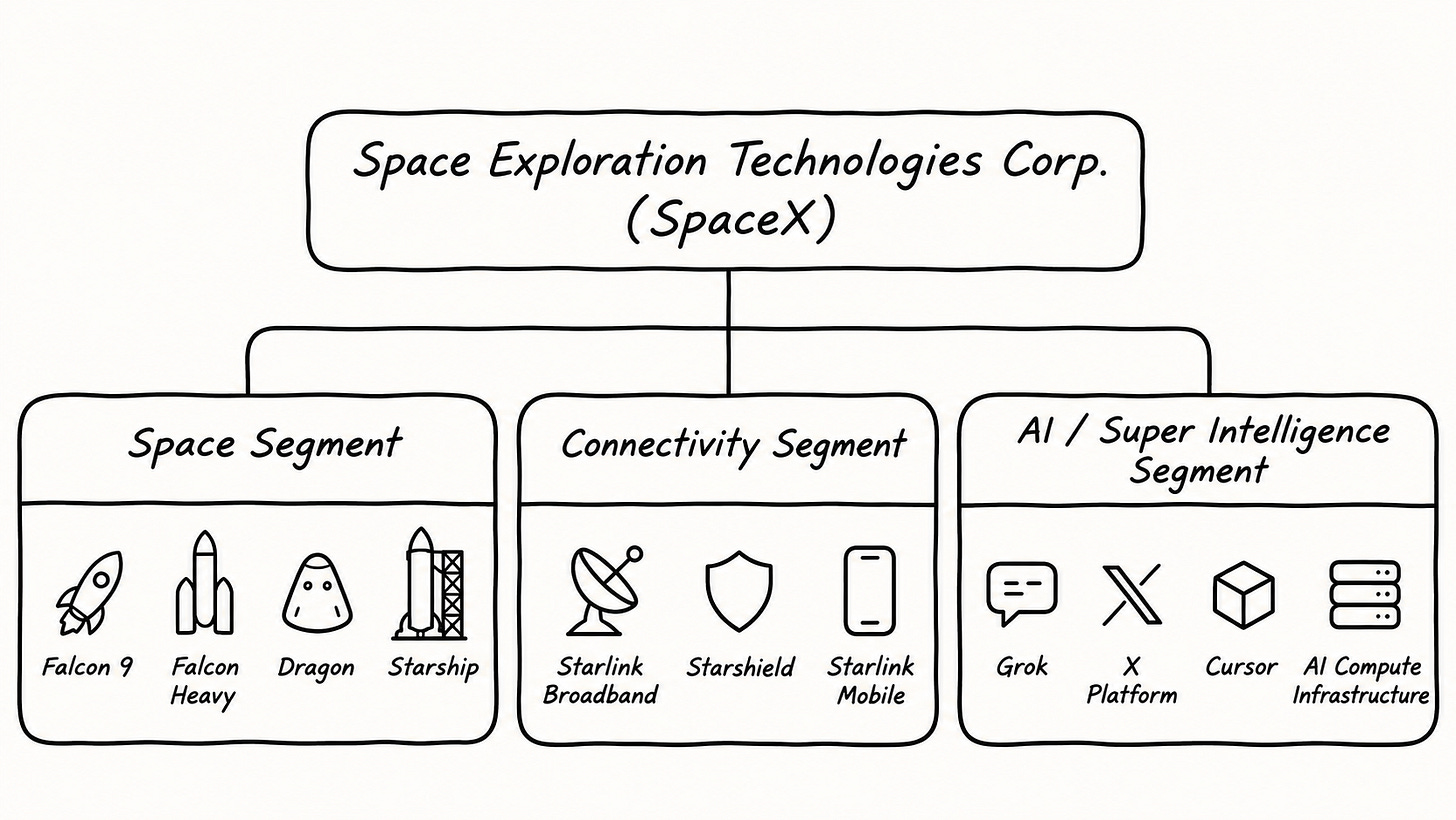
SpaceX now operates through three segments:
Space: Develops and launches rockets and spacecraft
Connectivity: Provides satellite-based internet and mobile connectivity
Super Intelligence (formerly AI): Develops AI models, operates X, and builds AI infrastructure
II
Musk has said in several interviews that in just a few years, digital intelligence will surpass all biological intelligence, and that there's no way to stop AI’s momentum. He also thinks humans will not stay in charge forever.
But losing control doesn’t mean losing all influence. Musk compared AI to raising a super-genius child. The child will grow too smart for his parents to control, but they can still teach him the values and beliefs they think are right.
For Musk, the question is not whether humans will control AI forever, but whose values will shape it.
He seems to believe that winning the AI race is essential to shaping the future he envisions. So he is leading a major shift toward AI at SpaceX, predicting that "AI will be 99% of the value of SpaceX" within five years.
Now, one thing is clear: SpaceX needed enormous amounts of money for AI.
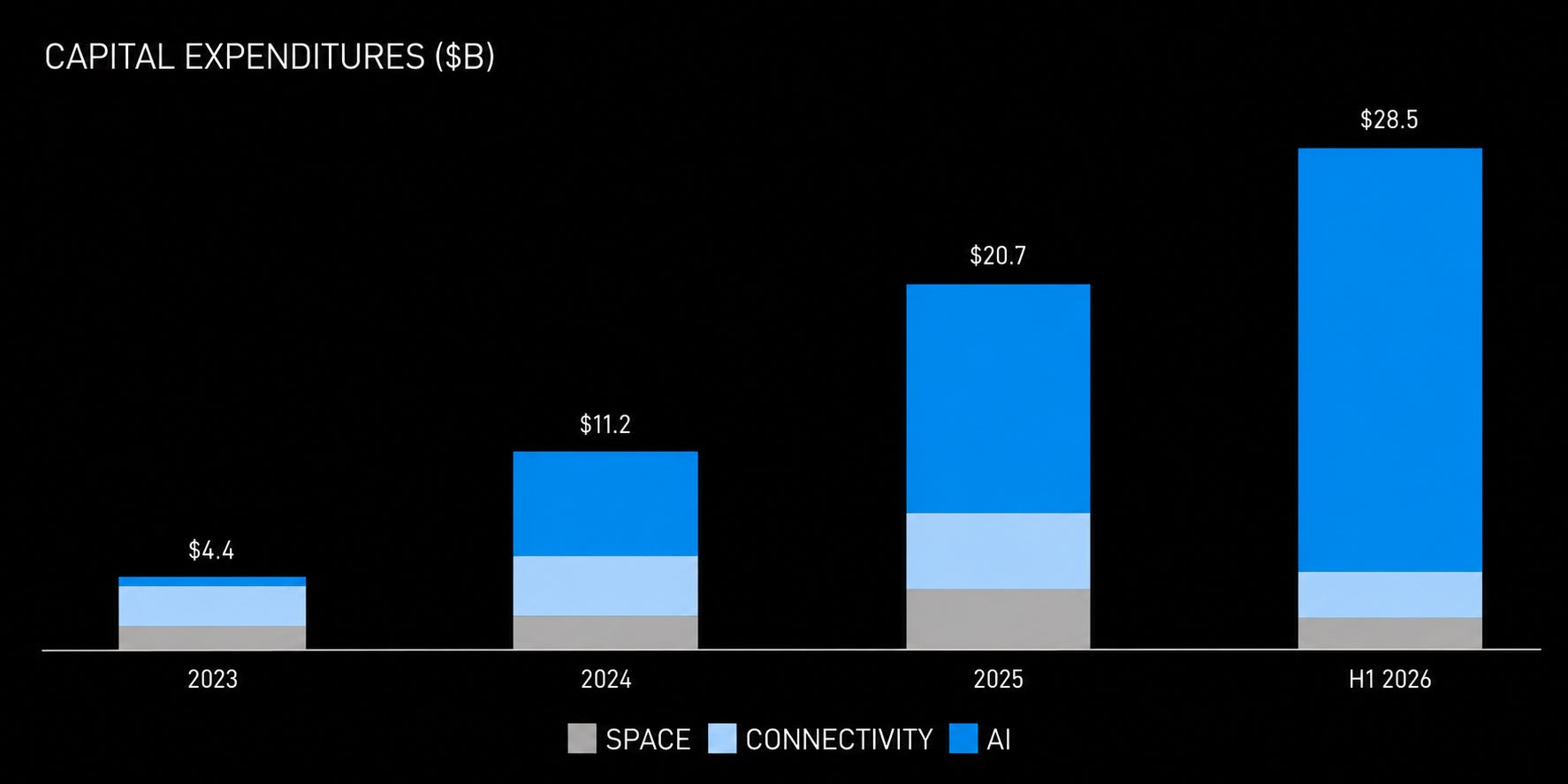
Even before the acquisition, xAI had been investing heavily in AI infrastructure.
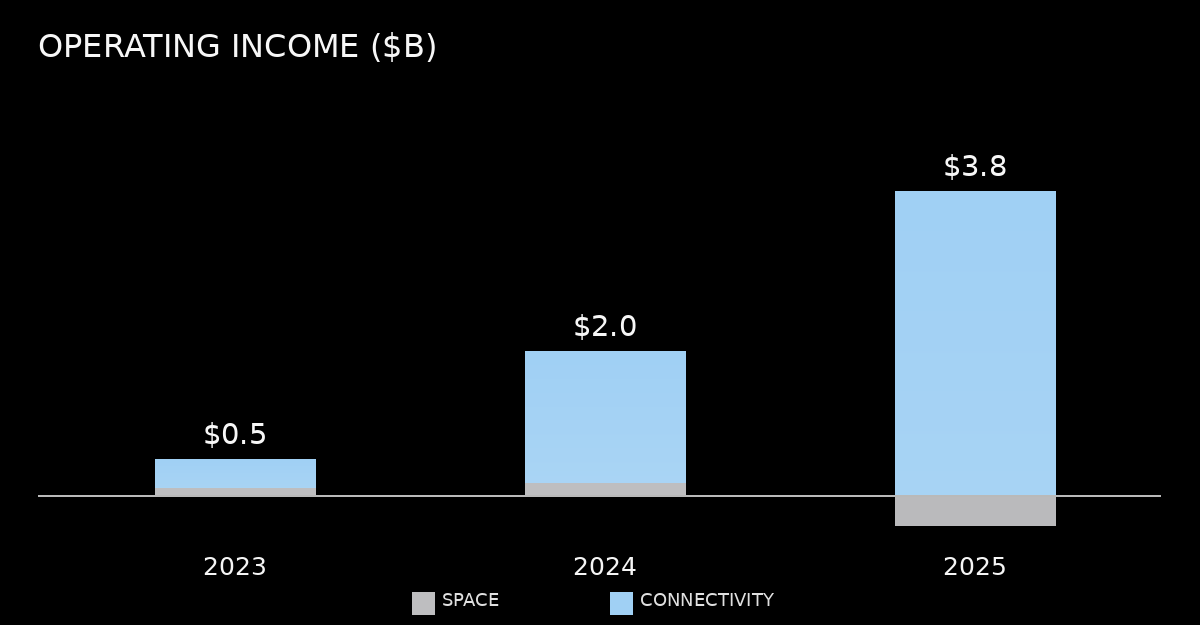
Meanwhile, Starlink had become SpaceX's cash cow, with operating income growing fast.
III
There were advantages to each part of the move: the IPO itself, the acquisition of xAI, and the timing.
First, going public is advantageous not only for raising a large amount of capital through an IPO, but also for raising capital repeatedly over the long term.
When private companies need more capital, they have to find investors and negotiate terms each time. The more money they need, the more unfavorable terms they may have to accept. Public companies, on the other hand, have access to a much broader pool of investors, making it easier to raise capital through follow-on offerings and other means.
The amount of money SpaceX needs is staggering. The company raised $85.7 billion through its IPO. Yet its total capital expenditures (CapEx) in just the first half of 2026 reached $28.5 billion, of which $23.6 billion went to the AI segment. And with massive projects like Terafab and Starmind still in their early stages, CapEx is likely to rise much further in the years ahead.
Second, xAI could leverage SpaceX's creditworthiness.
Before acquiring xAI, SpaceX was a financially strong company with unique technologies and rapidly growing revenue. xAI, by contrast, had enormous potential but was also buried in debt. By combining the two, Musk could leverage SpaceX's financial strength to raise large amounts of capital on favorable terms and invest that money in AI.
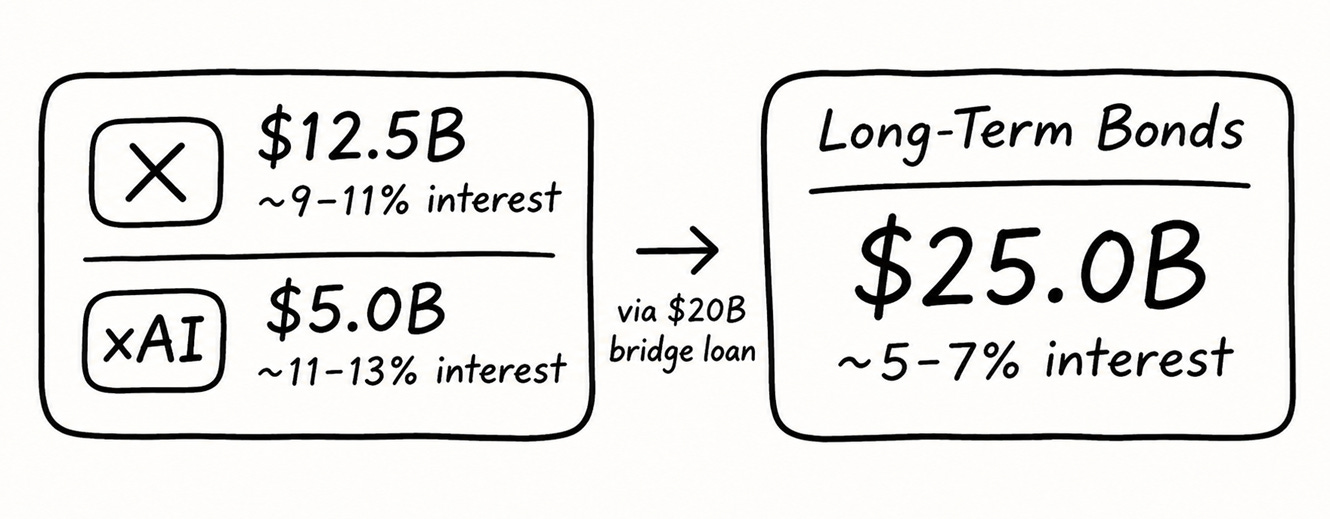
For example, just one month after acquiring xAI, SpaceX used a $20 billion bridge loan to refinance X's and xAI's high-interest debt. In June, SpaceX issued $25 billion in long-term bonds at lower interest rates than the original debt and used part of the proceeds to repay the bridge loan.
Third, the timing was exceptionally favorable for SpaceX's IPO, perhaps even more so than Musk had expected.
Starlink's steady revenue growth had demonstrated the strength of its business, helping SpaceX command a high valuation. That also meant SpaceX could raise the same amount of money while giving up a smaller share of the company. Meanwhile, enormous amounts of capital were pouring into AI infrastructure, and investors had high expectations for AI companies.
But four months after the IPO, in October, concerns about an AI bubble were growing. AI-related stocks fell, and investors grew more cautious about funding AI infrastructure. Then came November's midterm elections, adding further uncertainty. Democrats won control of both the House and the Senate, even flipping a Senate seat in Texas.
IV
SpaceX has two classes of shares: Class A and Class B.
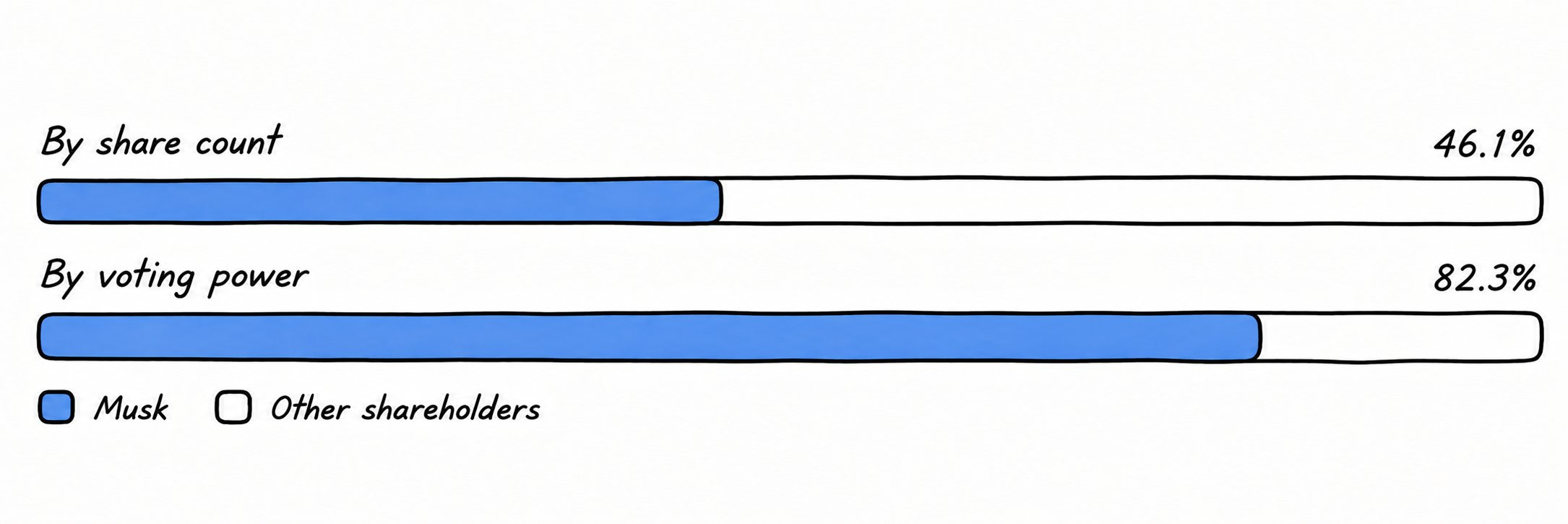
Class A shares are ordinary shares that can be bought on the public market. Class B shares, meanwhile, carry 10 votes per share. Immediately after the IPO, Musk held 91.6% of all Class B shares. Although he owned 46.1% of the company's total shares, he controlled 82.3% of the voting power.
Ahead of its IPO, SpaceX revised its corporate charter. Under the new rules, Class B shareholders have the exclusive right to elect 51% of the board of directors, and removing Musk requires approval from a majority of Class B shareholders.
In other words, Musk controls the board and cannot be removed against his will.
SpaceX also limited the influence of minority shareholders. It set a 3% ownership threshold for submitting certain shareholder proposals or filing derivative lawsuits, the highest threshold permitted under Texas corporate law. At SpaceX's IPO valuation, that was equivalent to roughly $53 billion.
Musk is still firmly in control of the company. But as a public company, SpaceX must disclose its quarterly financial results and major business risks. If losses grow or projects face delays, its stock price could fall and pressure from shareholders could intensify. Musk may have secured his control, but he cannot escape these obligations and pressures.
He may have decided that the risk of falling behind in the AI race outweighed the freedom he would sacrifice by taking SpaceX public.
I'm a curious person, but I've often struggled to get started because I tend to overthink things. So I decided to stop just thinking and start writing. I'm interested in the future, technology, and strategy. And to me, Elon Musk is probably the most interesting person in the world today.
This article focused on why SpaceX went public. But there are so many stories I'm even more excited to explore.
If you'd like to follow along, follow me on X or subscribe to Break Orbit!